More Ball Screw Manufacturers
Get a quote from the top leading Ball Screw Manufacturers.
What Applications Use Ball Screws?
Answer: Every engineer studying mechanical design courses is familiar with ball screws. A ball screw operates like a traditional lead screw but uniquely transmits load through ball bearings running in the helical channel. This design is essential for high-precision applications where converting a motor’s rotating motion to linear motion for the payload is required. Using a ball screw is one effective method to achieve this conversion.
Ball screws are high-performance mechanical linear actuators comprised of a screw shaft and nut, with a ball that rolls between the helical grooves of each component. Their primary function is to transform rotational motion into linear motion. Ball nuts are employed to transfer forces to a load with accuracy, precision, and consistency, whether the load is stationary or moving.
What makes ball screws unique is the rolling balls in the helical groove, which eliminate mechanical contact within the screw assembly and replace sliding friction with rolling friction. The efficiency of ball screws is determined by their ability to convert the energy used to produce rotational force into linear distance traveled.
Customers choose ball screws for their excellent control, low backlash, and minimal friction. Many advanced industries depend on ball screw assemblies, including semiconductor manufacturing, robotics, automated manufacturing, automotive production, aerospace engineering, military and defense applications, nuclear energy, and mechatronic systems.
Ball screws are precision mechanical components that convert rotary motion into linear movement with high efficiency and accuracy, making them essential across various applications. Here’s where they shine:
- CNC Machines
Ball screws drive the axes of lathes, mills, and routers, ensuring pinpoint precision—down to 0.001 inches—for cutting metal or plastic parts in manufacturing and aerospace. Ball screw-driven CNC machines are preferred for their repeatability, reduced backlash, and ability to handle continuous high-speed operation, making them vital in both prototyping and mass production. - Robotics
In robotic arms, ball screws deliver smooth, repeatable motion for tasks like welding, pick-and-place, and assembly. For example, FANUC robots use ball screws to assemble car parts with sub-millimeter accuracy. Ball screws are also vital in collaborative robots (cobots) and industrial automation where precise linear actuation improves productivity and safety. - Automotive Industry
Used in electric power steering (EPS) systems and assembly line actuators, ball screws provide responsive control and long-term durability—key for automotive manufacturing giants like Tesla. Ball screws also play roles in testing equipment, seat adjustment systems, and transmission control units due to their reliability and high thrust capabilities. - Aerospace
Aircraft rely on ball screws in flight control systems—flaps, rudders, landing gear—where lightweight strength (often steel or titanium alloys) and reliability under load are non-negotiable. Spacecraft and satellites also utilize miniature ball screws for deployment mechanisms due to their low friction and precise positioning. - Medical Equipment
Precision matters in MRI tables, surgical robots, and prosthetic limbs. Ball screws enable fine adjustments—sometimes microns—crucial for patient safety and device performance. In medical imaging, ball screws deliver smooth, silent operation with minimal vibration, essential for sensitive diagnostic equipment. - Industrial Automation
Conveyor systems, packaging machines, and 3D printers use ball screws for consistent linear motion, handling high-speed or heavy-duty cycles with minimal friction. Automated guided vehicles (AGVs) and material handling systems also leverage ball screws for lifting and precise motion control. - Semiconductor Manufacturing
Ball screws position wafers in chip-making equipment, offering nanoscale accuracy—vital for etching circuits in cleanroom settings. Their low particulate generation and high repeatability make them the actuator of choice for photolithography stages and probe stations in microelectronics fabrication.
From factory floors to operating rooms, ball screws excel where precision, efficiency (up to 90% vs. 50% for lead screws), and durability meet. If you’re evaluating motion control solutions, consider how ball screw assemblies can increase throughput, minimize maintenance, and deliver the reliability required in high-stakes environments.
History of Ball Screws
Ball screws came into existence in the late 1800s. Prior to their invention, people relied on lead screws for moving loads. These lead screws were screw and nut assemblies consisting of a threaded screw shaft and a nut. Unlike lead screws, ball screws incorporate ball bearings into the nut. This ball nut reduces friction and enhances efficiency.
Engineers initially crafted ball screws to aid in the linear motion load feeding of press machines. Although they proved effective, there wasn’t a standardized design. Inventors worldwide filed numerous patents for ball screws during the late 1800s and early 1900s. For instance, in 1874, an American named C.W. Crenshaw patented his “screw-press” mechanism design. Similar ball screw mechanism patents were also recorded in Germany (1879) and Great Britain (1909), among others.

Ball Screws Suppliers – Universal Thread Grinding Company
Despite the widespread interest from engineers, ball screws did not prove useful or consistent until around World War II. During the war, manufacturers began installing ball screws in airplanes. About a decade after the war, in 1955, General Motors started using ball screws in automobiles to assist with front wheel steering. Then, in the 1960s, manufacturers began using numerically controlled (NC) machinery, the predecessors of computer numerically controlled (CNC) machinery. To ensure smooth operation, they used ball screws as load feed components.
Nowadays, with the advancement of technology, ball screw designers are creating increasingly precise devices. Thanks to precision screw forming (PSF) processes, the production of inferior products, such as lopsided or off-center ball screws, has significantly decreased.
Using automated equipment, computer programs, and specialized sensors, they can efficiently locate the center of a steel rod intended for machining or rolling into a screw. This same technology allows for improved cutting and grinding of the material, resulting in more precise and consistent ball screw threading. Superior threads and grooves enable ball bearings to operate more smoothly and quickly. Moreover, with the aid of computer or operator supervision, the ball nut and load carriage of an assembly can be more precisely controlled. This results in fewer glitches, smoother movements, and quieter operations. As time progresses, we can anticipate continuous improvements in ball screw performance, especially as new manufacturing techniques, such as laser hardening and additive manufacturing, further enhance the quality and capabilities of ball screw components.
How have Ball Screws innovated over the last 20 years?
Answer: Over the past 20 years, ball screws have evolved significantly, driven by advances in materials, design, and manufacturing tech. Here’s how they’ve innovated since 2005:
Material Upgrades
Early 2000s ball screws leaned on standard steel, but now high-strength alloys—like hardened 52100 steel or stainless variants—boost load capacity and corrosion resistance. Ceramic balls (silicon nitride) emerged around 2010, cutting weight by 40% and friction, extending life in aerospace and medical apps.
Precision Engineering
CNC machining and grinding tech tightened tolerances—down to 0.0005 inches by 2015—thanks to companies like THK and NSK. Laser measurement and finite element analysis (FEA) refined designs, reducing backlash and boosting repeatability for semiconductor and robotics use.
Lubrication Advances
Self-lubricating ball screws hit the scene around 2008, with polymer inserts or grease reservoirs cutting maintenance. SKF’s sealed designs now last 5-10 years in dusty factories, up from 2-3 years pre-2010.
Miniaturization
By 2012, micro ball screws (diameters under 6mm) powered compact devices—think surgical robots or drones. Improved ball return systems (internal deflectors) shrank sizes without sacrificing smooth motion.
Smart Integration
Since 2018, sensors embedded in ball screws—like Bosch Rexroth’s IMS—monitor wear, temperature, and vibration in real time. Paired with AI, they predict failures, slashing downtime in automotive assembly.
Efficiency Gains
Optimized ball nut designs and recirculation paths hiked efficiency to 95% (from 85-90% in 2000s), per IEEE studies, cutting energy use in CNC and automation.
From tougher materials to smart tech, ball screws have grown more precise, durable, and versatile—powering everything from jets to 3D printers. If you’re seeking the latest high-efficiency, low-maintenance, and intelligent linear motion solutions, modern ball screw technologies are leading the way.
Ball Screw Materials
Choosing the right materials for ball screws is essential to guarantee their durability, reliability, and performance. Typically, ball screws consist of the screw shaft, ball nut, and balls. The screw shaft is usually crafted from high-quality alloy steel, such as chromium-molybdenum steel. This type of steel provides excellent strength, hardness, and wear resistance, ensuring the screw shaft can endure high loads and repetitive motion without deforming or breaking. Meanwhile, the ball nut, tasked with transferring rotational motion, is typically crafted from materials like brass or steel. These materials offer excellent strength and rigidity, allowing the ball nut to engage effectively with the screw threads and maintain long-term accuracy. Additionally, the balls within a ball screw are usually made from high-grade bearing steel or ceramic materials. These materials boast exceptional hardness, smoothness, and resistance to wear. The precise and consistent shape of the balls minimizes friction and backlash during operation, enhancing efficiency and positional accuracy. In summary, the materials chosen for ball screws ensure they can withstand high loads, maintain precision, and deliver long-lasting performance in various mechanical applications.
Looking to compare ball screw materials? Consider factors such as load requirements, environmental conditions (such as corrosive or high-temperature environments), and service life expectations. Stainless steel ball screws are ideal for cleanroom and medical applications, while ceramic ball bearings are preferred for high-speed or non-magnetic environments.
Main Components of a Ball Screw
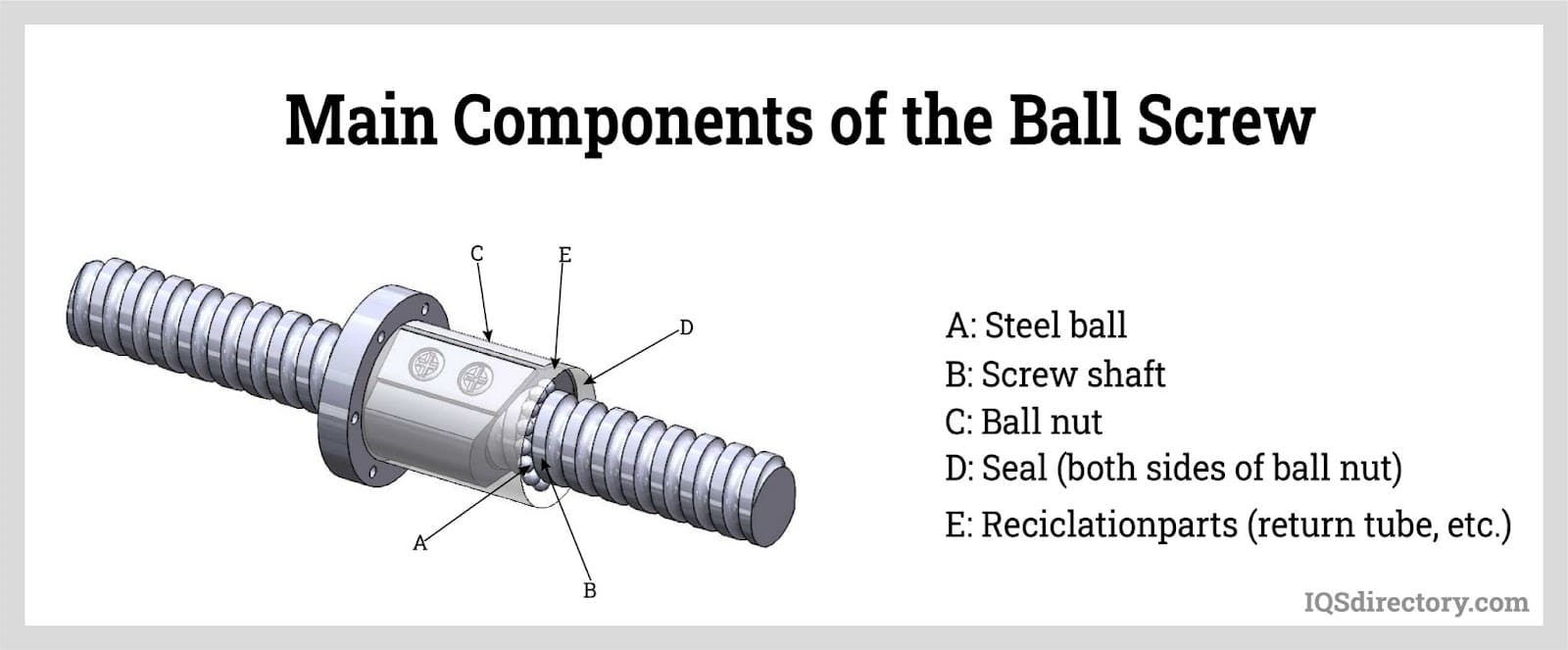
Following are the three main components of a ball screw:
Screw Shaft: The screw shaft is the part of the ball screw that receives rotational force, causing it to revolve around its axis and transform into linear motion. At one end of the shaft, a motor provides the necessary rotational power.
Nut: The ball bearing and its re-circulation system reside within a cylinder, functioning as the ball screw’s nut. Inside this nut, there are ball grooves designed to align perfectly with the grooves on the screw shaft.
Ball Bearing: The most prominent parts of a ball screw are the ball bearings, often referred to as the balls. These ball bearings travel within the clearance between the nut and the shaft, functioning as components that reduce friction. They are typically made of steel.
Together, these components work in harmony to deliver high-efficiency power transmission, low friction, and precise linear positioning for a wide variety of machinery and automation systems.
Ball Screw Considerations and Customization
When designing ball screws and ball screw assemblies, we consider various factors such as the type of load (static vs. dynamic), the weight of the load, the required critical speed (the speed that triggers the screw’s natural frequency), the mounting type, the environment (potential exposure to dirt, dust, and other contaminants), temperature, frequency of use, and the required accuracy.
Considering these factors, manufacturers make decisions about materials, ball nut shape (rounded nut, flanged nut, or custom nut), protective coatings, lubrication, ball nut size (ball circle diameter), screw diameter (root diameter, pitch, lead, etc.), the screw’s load direction, and the type of mounting. During the design process, they determine whether to create a preloaded ball screw system. Preload is a positioning method that enhances assembly rigidity by removing the clearance between the ball nut and ball screw. This process eliminates the backlash and deflection typically associated with carrying large loads. Manufacturers generally achieve preload by using oversized balls, adjustable nuts, or by tensioning two single nuts.
In addition to our standard configurations, buyers can request ball screws tailored to their specific needs. Custom ball screws provide the assurance of seamless productivity and compatibility. Popular customizations include various ball diameters, unique screw diameters, metric system conversion (mainly for international use), single or double ball nuts, specialized screw ends, and personalized nut designs.
Not sure which configuration is right for your application? Ask yourself: What load capacity do I need? What is the maximum speed and acceleration required? Does my environment require corrosion resistance or special lubrication? Exploring these questions with your supplier will help you choose the ideal ball screw assembly for your system.
Ball Screw Features
Ball screws consist of two main components: a screw shaft and a ball screw nut. Ball bearings run up and down the helical grooves of the screw. For proper functioning, the threading of the nut must match the threading of the screw. Together, the nut and the threaded screw form a ball screw assembly, which generates torque and thrust. It’s important to note that the nut is a non-contact ball, operating without ever physically touching the screw shaft.
This movement starts with ball bearings rolling in the grooves of the threads, creating a smooth motion while also generating rolling friction. Next, the ball bearings encounter a deflector positioned inside the nut’s ball return system. This deflector redirects the ball bearings to the opposite end of the nut, allowing them to continuously recirculate.
Key features of ball screw assemblies include minimal backlash, high positioning accuracy, long service life, and efficient conversion of rotary input into linear output. The recirculating ball design ensures consistent performance under varying loads, while advanced sealing options protect against contamination in demanding environments.
Types of Ball Screws
To meet the diverse needs of their applications, ball screws come in multiple configurations, including miniature, rolled, ground, and precision types.
Miniature ball screws are popular for use in lasers, gauge measurement devices, semiconductors, medical instruments, and other small devices requiring smooth and precise linear motion.
Rolled ball screws, or roll ball screws, get their name from their formation process: starting as blank metal workpieces, they are shaped through cold screw rolling. These rolled ball screws boast impressive positional precision, accurate to several thousandths of an inch per foot. The threads are formed by cold work deformation, where the uncut blank shaft is passed through rotating tool dies, leading to substantial plastic deformation that produces a high-strength screw shaft. Compared to ground screws, rolled screws are more cost-effective and simpler to manufacture.
Ground ball screws, known for their exceptional precision, are crafted through a three-step process: machining to a rough shape, case hardening, and grinding. The grinding occurs on high-speed machines coated with abrasive materials. This process endows the finished screws with the capability to endure temperatures that would typically cause distortion and reduce efficiency. Ground ball screws are ideal for applications demanding both high precision and high stiffness.
Precision ball screws encompass a broader category of ball screws designed to achieve exceptionally high levels of accuracy.
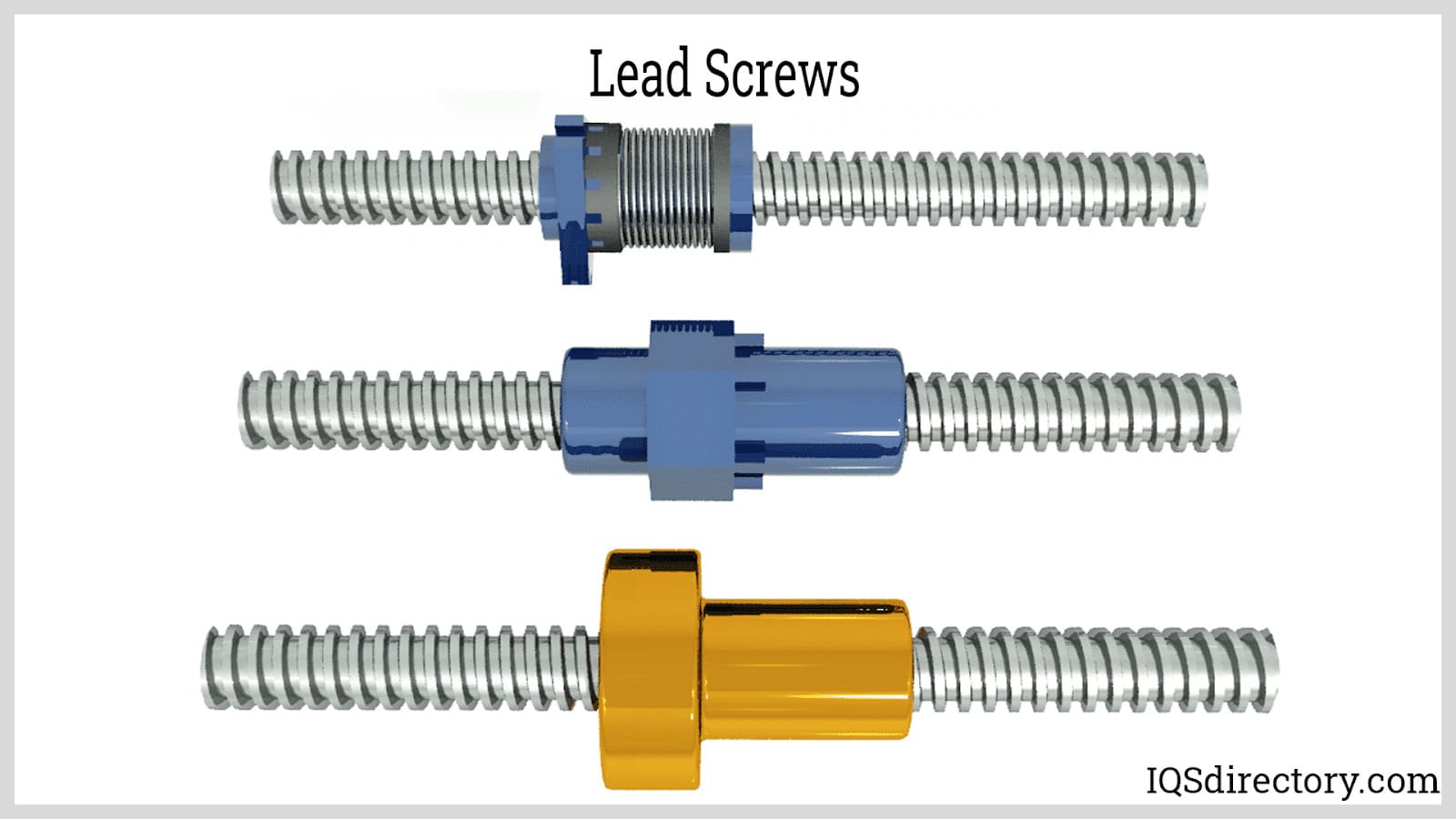
Lead screws, though not technically ball screws, are sometimes classified in the same category due to their ability to convert rotational motion into linear motion. Comprising a threaded screw shaft and a nut, lead screws generate friction through sliding rather than the rolling action typical of ball screws. Because of this reliance on sliding action, lead screw assemblies exhibit a relatively low efficiency, ranging from 25% to 75%. Lead screws typically feature either an acme screw design or a trapezoidal lead screw design, each characterized by its unique threading pattern and shape.
Ground screw threads are crafted through an abrasive process. A coarse abrasive cutter shapes the metal, carving out the grooves while the blank shaft remains horizontal. The resulting grooves are smoother compared to those of rolled screws. This method yields high-precision ball screws, albeit at a higher cost and slower production rate.
Return-pipe type ball screws are designed with an exterior tube extending from the nut’s wall, guiding the balls back to their starting position. The return tube directs this flow, aided by fingers attached to the tube’s ends, ensuring smooth entry and exit for the balls. A tube retaining bracket supports the return tube along its length, making assembly and disassembly straightforward.
Need help comparing ball screw types for your application? Consider searching for:
- What are the differences between rolled and ground ball screws?
- When should I use a miniature ball screw over a standard size?
- How does a return-pipe system affect ball screw performance?
Advantages of Ball Screws
Ball screws offer numerous advantages that make them highly beneficial for various applications. They boast efficiency levels of up to approximately 90%, significantly higher than those of lead screws, all while maintaining low energy consumption. Their precise tolerances, ability to withstand high thrust loads, and low friction levels make them exceptionally reliable. Additionally, they operate at low temperatures, contributing to the longevity of systems. This efficiency and durability make ball screws a cost-effective investment. Regardless of their configuration or whether they adhere to American or metric standards, ball screws are a valuable asset for manufacturers and engineers.
Additional benefits include:
- Quiet operation and smooth motion, ideal for sensitive environments
- Low maintenance requirements due to advanced lubrication systems
- Scalability for both miniature and heavy-duty high-load applications
- Wide compatibility with servo motors, stepper motors, and actuators
Curious about how ball screws can improve your production line, medical device, or robotic system? Explore our case studies or contact our engineering team for application-specific guidance.
Ball Screw Accessories
Several specific ball screw accessories enhance the performance and versatility of ball screws. Screw jacks, for instance, convert rotary motion into linear motion and are commonly used in applications requiring heavy load lifting or precise positioning. Screw support bearings provide axial and radial support to the ball screw shaft, minimizing deflection and maintaining stability during operation. These bearings come in various configurations, including angular contact bearings, deep groove bearings, and thrust bearings, depending on the specific load and speed requirements. Additionally, recirculation caps are used in conjunction with ball nut assemblies. They guide the recirculating balls back into the ball nut, ensuring smooth and efficient motion. Furthermore, mountings like flanges and brackets secure the ball screw assemblies in place, enabling easy installation and integration into various systems. Extra ball nuts are available to serve as backup or replacement components, allowing quick and convenient interchangeability and minimizing downtime during maintenance or repair. Proper lubrication is vital for ball screw performance, and lubricant accessories like fittings and oil seals ensure optimal lubrication, reducing friction and wear. Additionally, wipes such as lint-free cloths or swabs are handy for cleaning and maintaining the ball screw components, removing contaminants and extending their lifespan. Together, these specific ball screw accessories contribute to the smooth operation, longevity, and adaptability of ball screws in diverse applications.
Do you need to upgrade your ball screw system with specialized accessories? Search for:
- Best ball screw support bearings for high-speed operation
- How to select the right lubrication fittings for ball screws
- Which mounting brackets are compatible with my ball screw assembly?
Proper Care of Ball Screws
A well-maintained ball screw, properly lubricated and free from interferences like dust, will prove to be an essential component in many operations. Establishing a regular cleaning schedule is crucial, and usually, a simple wipe-down will suffice. To determine the best lubricant for your ball screw assemblies, consult your supplier. For added durability, consider preloading your ball screw assembly, as preloaded assemblies offer increased rigidity, beneficial for certain systems. If you’re uncertain about preloading, discussing it with your supplier is advisable.
To keep our ball screw assembly in top condition, we should test the ball nut component to ensure proper alignment. Misalignment can lead to significant damage to the ball screw. Additionally, it’s best to leave our ball screws in their packaging until we’re ready for installation, as dust can negatively impact their performance. For long-term storage, rotating the ball screws every few months helps to maintain even oil distribution.
Looking for a maintenance checklist for your ball screw assembly? Consider these questions:
- How often should you lubricate your ball screws based on application intensity?
- What are the signs of ball screw wear or misalignment?
- Which cleaning supplies are safe for use with precision ball screw assemblies?
Ball Screw Standards
The standards that your ball screws must adhere to vary based on your industry, application, machinery, working environment, and location. Common standards for accuracy, ball screw dimensions, and load tolerances are provided by organizations such as the ISO (International Standards Organization) and equivalent national bodies. Examples include DIN (Deutsches Institut für Normung or German Institute for Standardization), BSI (British Standards Institute), JIS (Japanese Industrial Standards), ANSI (American National Standards Institute), and SCC (Standards Council of Canada), among others.
Are you unsure which standards apply to your specific use case? Try searching for:
- What are the ISO accuracy grades for ball screws?
- How do JIS and DIN ball screw standards compare?
- Which certifications are required for medical or aerospace ball screw assemblies?
Choosing the Proper Ball Screw Manufacturer
To ensure we achieve the best results when purchasing ball screws, it’s essential to compare several companies using our directory of ball screw manufacturers. Each manufacturer has a business profile page that highlights their expertise and capabilities, along with a contact form for direct communication. This allows us to ask questions or request quotes easily. By using our patented website previewer, we can quickly learn what each company specializes in. Finally, we can use our straightforward RFQ form to reach out to multiple ball screw businesses simultaneously.
When evaluating manufacturers, consider asking these questions:
- What is your experience with custom ball screw design for my industry?
- Can you provide references or case studies for similar applications?
- What lead times and after-sales support do you offer?
- Are your ball screws compliant with all required industry standards?
Get a quote from the leading manufacturers of Ball Screws.
Ready to take the next step? Whether you’re designing new equipment, upgrading existing machinery, or seeking a reliable replacement, ball screws offer unmatched precision, efficiency, and durability for linear motion applications.
For more information, explore our comprehensive directories, access technical resources, or request a custom quote tailored to your specific needs today.
What applications use ball screws?
Ball screws are essential mechanical components used to convert rotary motion into precise linear motion. They are commonly found in CNC machines, robotics, the automotive industry, aerospace applications, medical equipment, industrial automation, and semiconductor manufacturing. Their high efficiency, low friction, and accuracy make them indispensable in environments requiring repeatability and minimal backlash, such as manufacturing lines, operating rooms, and cleanrooms.
How have ball screws innovated over the last 20 years?
Ball screws have seen significant innovation over the last 20 years, including the adoption of high-strength and corrosion-resistant alloys, ceramic balls for reduced friction and weight, tighter tolerances achieved through advanced CNC machining, and the development of self-lubricating and sealed designs for longer service life. Integration of sensors for smart monitoring, advancements in miniaturization, and optimized designs have greatly increased their efficiency, durability, and precision for modern automated and industrial applications.
What are the main components of a ball screw?
The main components of a ball screw assembly are the screw shaft, the nut, and the ball bearings. The screw shaft rotates to create linear motion, the nut contains ball grooves matching those on the shaft, and the ball bearings roll between the nut and the shaft to minimize friction and transmit force efficiently. This combination enables precise power transmission in automation systems.
What types of ball screws are available?
Ball screws come in several types to meet various application needs, including miniature ball screws for compact devices, rolled ball screws known for cost-effectiveness, ground ball screws offering high precision, and precision ball screws for extremely accurate positioning. Return-pipe type ball screws feature an exterior tube for ball recirculation, and rolled vs. ground screws differ in manufacturing process, cost, and achievable tolerances.
What are the advantages of ball screws compared to other linear actuators?
Ball screws offer higher efficiency (up to 90%), greater accuracy, low friction, better energy savings, and increased load capacity compared to traditional lead screws. Additional benefits include quiet operation, low maintenance, long service life, scalability, and compatibility with various drive motors. These features make ball screws a reliable choice for demanding industrial, medical, and automation environments.
How should ball screws be maintained for optimal performance?
To maintain ball screws, regularly clean the components to remove dust and contaminants, use the appropriate lubricant recommended by the supplier, and follow a scheduled maintenance routine for lubrication and alignment checks. Preloading the assembly can increase rigidity, and ensuring proper storage and periodic rotation help preserve ball screw condition and longevity.
What factors should be considered when customizing or selecting a ball screw?
Key considerations when selecting or customizing a ball screw assembly include load type (static or dynamic), weight, critical speed, mounting type, environmental conditions, required accuracy, material selection, ball nut design, protective coatings, lubrication, and whether preloading is needed. Customizations can also involve ball diameter, screw ends, and compliance with metric or imperial standards, depending on application requirements.
 Ball Bearings
 Ball Screws
 Electric Motors
 Friction Materials
 Gears
Gears Quick Release Couplings
 Shaft Couplings
 Speed Reducers
 Timing Belting
 Castings & Forgings
 Bulk Material Handling
 Electrical & Electronic Components
 Flow Instrumentation
 Hardware
 Material Handling Equipment
 Metal Cutting Services
 Metal Forming Services
 Metal Suppliers
 Motion Control Products
 Plant & Facility Equipment
 Plant & Facility Supplies
 Plastic Molding Processes
 Pumps & Valves
 Recycling Equipment
 Rubber Products & Services